
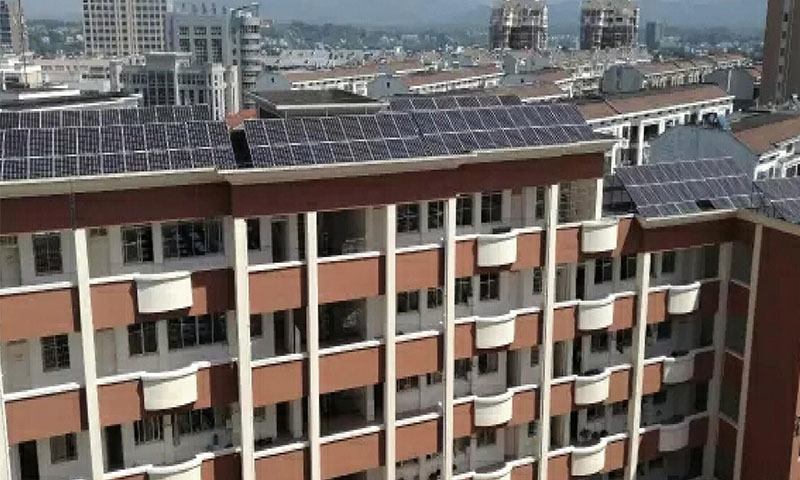
As a key high school in Pingjiang County, Hunan Province, Pingjiang No.1 Middle School has long been committed to improving educational quality and campus sustainability, aiming to establish itself as a green low-carbon education demonstration base. In 2016, our company actively responded to the "Education Support + Environmental Protection" initiative by investing in and donating a 70kW distributed photovoltaic power generation project. This project supports educational development through clean energy, channeling power generation revenue into rewarding outstanding teachers, pioneering an innovative model of "green energy + educational incentives."
System configuration
Capacity: 70kW, covering 800m² of rooftop area
Modules: 182 high-efficiency 182mm monocrystalline silicon panels (550W each), arranged flexibly for irregular layouts.
Inverter: 2×30kW string inverters (IP65-rated), compatible with multi-orientation rooftops.
Energy Storage: 10kWh battery system for emergency lighting backup.
Safety & Aestheic Design
Lightweight aluminum alloy brackets to reduce roof load.
Triple-layer lightning protection and smart leakage monitoring.
Color-matched panels harmonized with campus architecture.
Technical Adaptability & Reliability
Energy Output: 70kW system partially meets campus electricity demand.
ROI: 5-year payback period based on comparable projects, with stable long-term returns.
Maintenance: Dedicated technical team provides regular upkeep and real-time data monitoring.
| Metric | Data |
| Annual Power Generation | 78,000 kWh |
| Annual Cost Savings | ¥43,000 |
| Annual CO2 Reduction | 72 tons |
| Lifetime CO2 Reduction (25y) | 1,800 tons |
The project not only reduces campus carbon footprint but also creates a sustainable public welfare loop through “energy revenue reinvestment in education.” Estimated annual output of 78000 kWh equates to 72 tons of CO2 reduction, demonstrating dual environment and educational value.
School administrators commented:
“This photovoltaic system alleviates our energy cost pressures while motivating teachers through specialized incentives. It represents an exemplary model of school-enterprise collaboration”.